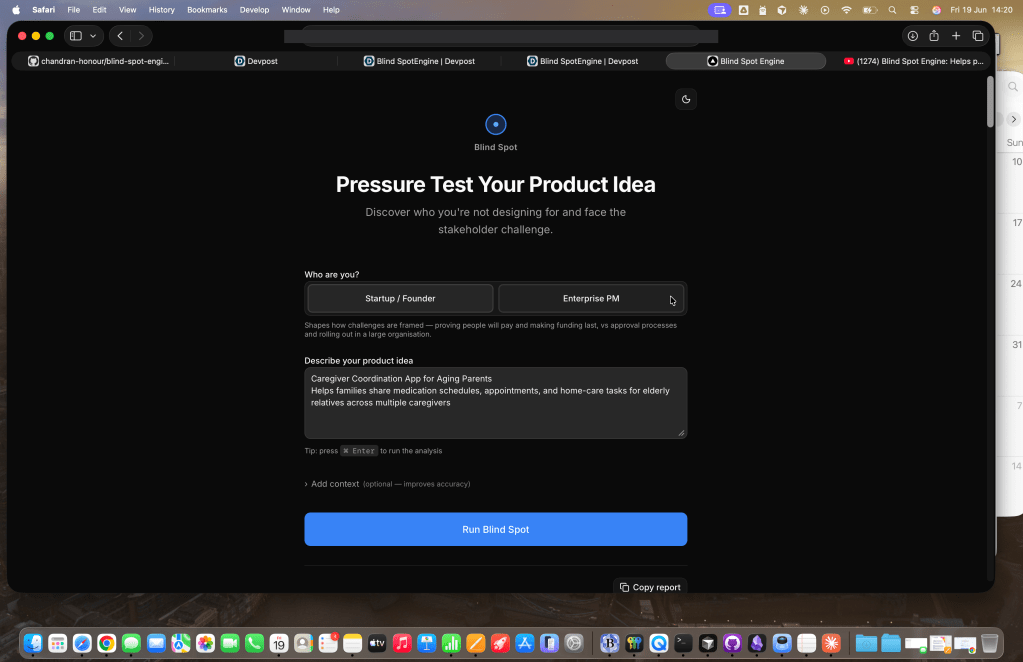
[Screenshot: BlindSpot Engine input screen — “Pressure Test Your Product Idea”, showing the Startup/Founder and Enterprise PM mode selector and a product idea entered for a Caregiver Coordination App]
June 2026 · Mind the Product Hackathon
Blind Spot Engine is an AI-powered product pressure testing tool that stress-tests your product idea across excluded personas and stakeholder challenges, before you’ve committed to building it – Try it at blindspotengine.app
Blind Spot Engine takes a product idea and runs it through two phases of analysis.
The first identifies the people your product structurally leaves out by design, by assumption, or by circumstance and why that matters. The second is a full product stress test across four stakeholder lenses: Business & Finance, Product & PM, Technical & Engineering, and Delivery & Operations, each surfacing the concerns their real-world counterparts would raise, with a concrete next step attached.
The output streams directly into the browser. No account needed. You paste in an idea and a structured product validation report comes back specific to your idea, not product development in general. That specificity is what makes it useful rather than just plausible-sounding.
The tool has two modes — Startup/Founder and Enterprise PM — because the product development challenges are genuinely different depending on which world you’re building in. Internal products in large organisations don’t fail because of customer acquisition. They fail because of governance sign-off, data platform backlogs, and political dynamics between teams. A single-mode product validation approach misses all of that.
The Product Development Challenges Along the Way
I built it solo, part-time, in under a month, fitting sessions around family commitments in 1–2 hour windows after the kids are in bed. The stack is Next.js 14 + TypeScript + Tailwind, deployed on Vercel, powered by Claude claude-sonnet-4-6.
The productivity comparison is stark: roughly 75 hours with Cursor as the coding agent versus an estimated 150–220 hours for a product manager re-learning framework patterns from scratch. That 100+ hour gap is the difference between shipping and not shipping.
The build surfaced something that applies broadly to anyone doing AI product development: vibe coding gets you a sketch. What gets you a product is stopping, writing down what you’re actually building, defining the data model, documenting the logic, and then returning to the agent with a clear brief. The discipline came second, not first — and I’d apply it earlier next time.
The real engineering challenge was prompt design. The difference between a system prompt that produces generic startup advice and one that produces genuinely uncomfortable, idea-specific product validation is large — and not obvious from the structure of the output alone. Getting there took eleven major test runs and a scoring rubric before the results started consistently feeling like what an honest colleague would actually say.
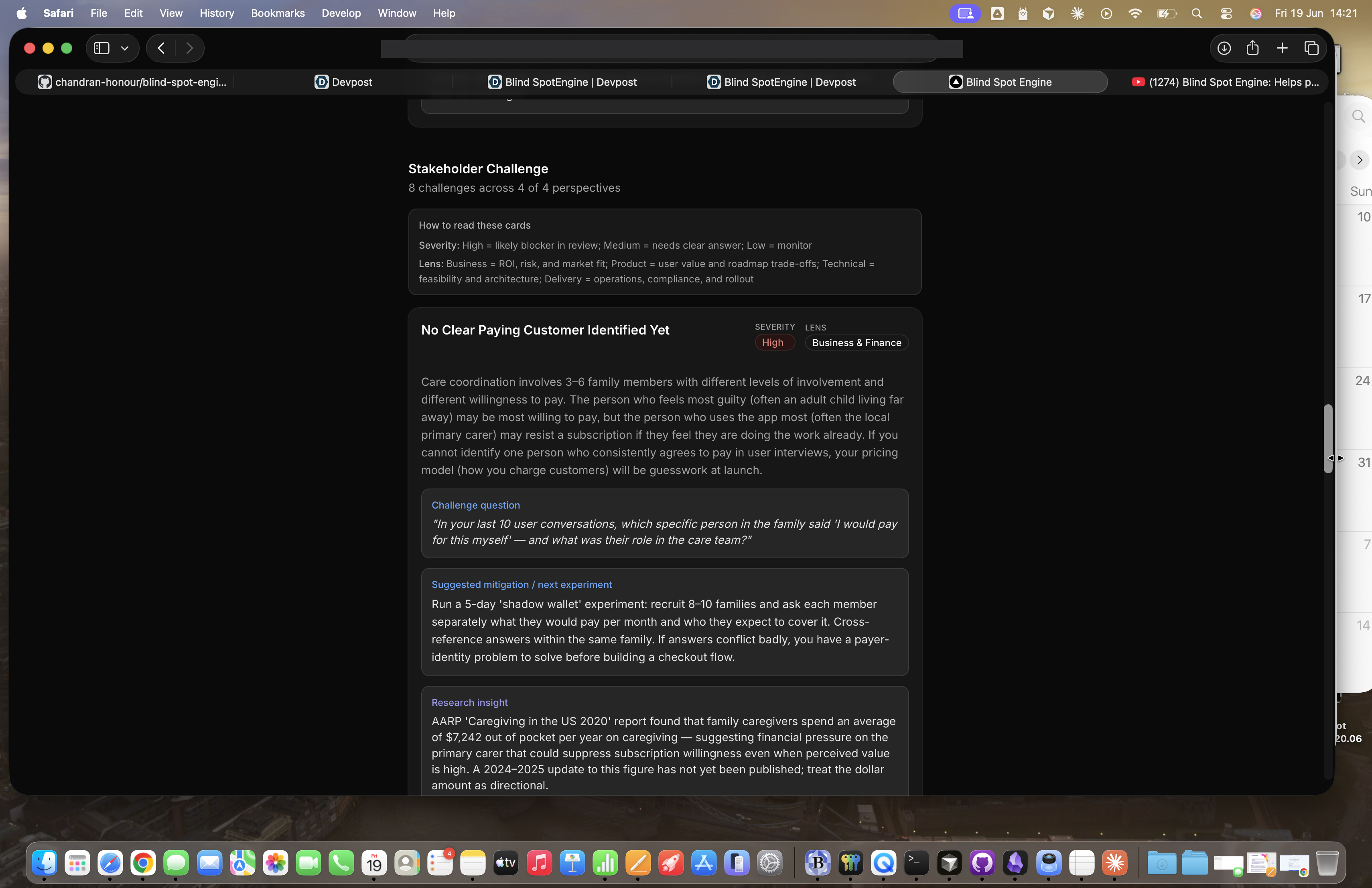
[Screenshot: BlindSpot Engine results — Stakeholder Challenge card “No Clear Paying Customer Identified Yet” (High severity, Business & Finance lens) for a Caregiver Coordination App, with a specific challenge question and a suggested next experiment]
Read the Full Write-Up
If any of this sounds familiar the half-helpful advice, the product validation that comes too late, the structured thinking that everyone knows they should do and rarely does the full project write-up is on Devpost.
It covers the build in detail: the architecture, the prompt engineering process, the product stress testing and evaluation pipeline (including two custom Claude agent skills I built to automate it), what worked, what I’d do differently, and what’s next for the product.
Read the full project write-up →
Blind Spot Engine was built for the Mind the Product Hackathon, June 2026. Agentic engineering powered by Claude Sonnet 4.6 and Cursor.


Leave a Reply